 . It is also assumed that servicing each aperiodic request
requires exactly
. It is also assumed that servicing each aperiodic request
requires exactly  time units.
Given an environment that supports
10 periodic tasks, one of which is a deferrable server servicing a sequence
of aperiodic requests, design the deferrable server, i.e. choose its period
and run time, so that it responds to the requests with the minimum of delay.
The aperiodic requests can be modelled as a poison process with . It is also assumed that servicing each aperiodic request
requires exactly time units.
Solution:
To obtain the best response in the environment described above, one
chooses a period for the deferrable server so as at most one request will happen
within any given period.
Under such an arrangement, the deferrable server
will always wake up as soon as an aperiodic request occurs, and service it giving
a response time of exactly  . (We assume, that
  is small compared to the period of the server, and thus
the probability that an aperiodic request would arrive within m from the end
of the period and that there will be another request during the subsequent period,
is negligible. This assumption has been made in order to simplify the calculations.
In fact, if the request arrives within m of the end of the period, will force
the processing to spill over the next period, and any requests arriving then
will be delayed until the subsequent period.)
is small compared to the period of the server, and thus
the probability that an aperiodic request would arrive within m from the end
of the period and that there will be another request during the subsequent period,
is negligible. This assumption has been made in order to simplify the calculations.
In fact, if the request arrives within m of the end of the period, will force
the processing to spill over the next period, and any requests arriving then
will be delayed until the subsequent period.)
If the period were to be larger, then more than one requests would occur within a period, and the second and subsequent requests would have to be serviced during the subsequent period of the server.
Since the aperiodic requests constitute a random process, we cannot guarantee that at most one request will occur during each period. The most that we can hope for, is to minimize the probability that more than one requests would occur.
Additionally, since the aperiodic requests
constitute a random process, we must ensure that adequate computation resources
are devoted to them, that is, 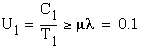 .
.
Assuming a poison arrival discipline, the probability
that k requests arrive in an interval of length t is given as 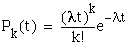 .
.
Then the probability that there is at least
one request in an interval of length t is  .
.
Similarly, the probability that exactly one
request occurred in an interval of length t is  .
.
Thus, the probability that exactly one request occurs in an interval of length t, given that this interval contains at least one request, is
 .
.
The above expression, can now be solved for the interval length t.
The following table summarizes various alternatives,
under the assumptions that  and that there are a total of 10 (including the deferrable server)
tasks. The processor utilization allocated to the 9 periodic tasks, denoted
as
and that there are a total of 10 (including the deferrable server)
tasks. The processor utilization allocated to the 9 periodic tasks, denoted
as  is computed from the least upper bound of the utilization (to ensure
feasibility) and is
is computed from the least upper bound of the utilization (to ensure
feasibility) and is

|
Table 4 | |||
|
|
|
|
|
|---|---|---|---|
|
0.95 |
0.1017 |
0.9832 |
0.0226 |
|
0.9 |
0.2071 |
0.4828 |
0.2366 |
|
0.8 |
0.4308 |
0.2321 |
0.4316 |
|
0.5 |
1.2564 |
0.07959 |
0.6038 |
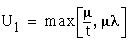
1. The maximum is used, in order to ensure that there is enough
time to process al the aperiodic requests, which on the average require that
the utilization be at least  (c.f. (3.15)).


 1
1